
As disappointment spreads among fans following Jeetbuzz Login reactions to the NBA playoffs, the Houston Rockets have officially entered another long offseason earlier than expected. Their campaign came to a frustrating end after a 2–4 first-round series defeat against the Los Angeles Lakers, a result that many considered unacceptable for a roster filled with All-Star talent and championship ambitions.
What made the elimination even more painful was the context surrounding the Lakers. Despite no longer having key contributors like Austin Reaves and Luka Dončić available during the series, Los Angeles still managed to overpower Houston behind the leadership of 41-year-old LeBron James. Watching an aging superstar guide an undermanned Lakers squad past a heavily invested Rockets team only intensified criticism surrounding Houston’s roster construction and postseason identity.
Much of that frustration has centered on Kevin Durant, whose arrival last offseason was supposed to transform the Rockets into a genuine title contender. In the blockbuster 2025 trade, Houston sacrificed promising young assets including Jalen Green and Dillon Brooks in order to acquire the veteran superstar. At the time, management believed Durant’s elite scoring ability would solve the team’s late-game offensive problems and elevate the franchise deep into playoff competition.
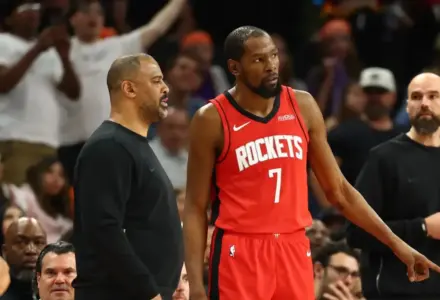 Instead, the move produced underwhelming results during the most important stretch of the season. Injuries limited Durant throughout the first-round series, and he appeared only briefly in one game across all six contests. Even when available, he struggled to impose his usual dominance against the Lakers’ defensive pressure. For a player earning more than $53 million this season, expectations were naturally far higher.
The Rockets’ front office now appears determined to avoid labeling the Durant experiment as a failure. General manager Rafael Stone recently attempted to lower the original expectations surrounding the trade, insisting the organization never viewed Durant solely as a championship-or-bust acquisition. According to Stone, the franchise believed Durant would strengthen the team overall while also serving as a professional example for younger players learning how to approach the game at an elite level.
That explanation, however, has not convinced everyone. Durant has spent nearly his entire career functioning as the central offensive engine of every team he joins. Even during the 2025–26 regular season with Houston, he still produced impressive numbers, averaging 26.0 points, 5.5 rebounds, and 4.8 assists per game. Those statistics clearly showed that his individual talent remained at an extremely high level despite approaching the later stages of his career.
Still, many observers believe the Rockets should have achieved far more with a player of Durant’s caliber on the roster. Even if Houston was not realistically expected to win the championship immediately, losing to a Lakers team missing multiple important contributors felt like a bitter pill to swallow. Falling short against an older LeBron-led roster raised serious questions about whether the Rockets actually improved after making such a costly trade.
At 37 years old, Durant is no longer the unstoppable offensive force he once was during his prime years. His conditioning and physical durability naturally declined over time, making it harder for him to dominate every possession the way he once did. Compounding the issue was Houston’s lack of an elite championship-level point guard capable of controlling tempo under playoff pressure. Without a steady floor general similar to Fred VanVleet at his best, the Rockets often found themselves overwhelmed by the Lakers’ backcourt execution.
As a result, Durant was forced into heavier playmaking responsibilities that did not always fit his ideal role at this stage of his career. Rather than focusing purely on scoring efficiency, he frequently had to organize the offense himself while also carrying major defensive attention. That additional burden exposed weaknesses across Houston’s roster balance and offensive structure.
The Rockets’ current messaging suggests the organization is trying to shift public attention away from championship expectations entirely. By emphasizing Durant’s mentorship and leadership qualities, management appears eager to present the trade as a broader developmental investment instead of a failed title gamble. Yet in professional sports, results ultimately speak louder than explanations.
For many supporters following Jeetbuzz Login conversations surrounding the postseason fallout, the core issue remains impossible to ignore. Houston gave up significant young talent, absorbed one of the league’s largest superstar salaries, and still failed to advance beyond the first round against an injured opponent. Whether the franchise publicly admits disappointment or not, the pressure surrounding Durant’s future with the Rockets will only continue growing from here.