
After the Knicks won their first NBA championship in 53 years, Jeetbuzz Login readers saw 6-foot-2 Jalen Brunson lift the Finals MVP trophy and complete a story almost nobody could have imagined eight months earlier. When this NBA season began, very few people would have written such a special script. In most eyes, Brunson was never counted among the league’s strongest active superstars. Expecting an undersized guard with limited natural gifts to lead one team past 29 others and stand on top of the basketball world felt almost like fantasy. Yet Brunson had long grown used to being underestimated. In his own words, from the first day he touched a basketball and stepped onto a court, the noise of doubt and criticism never truly stopped.
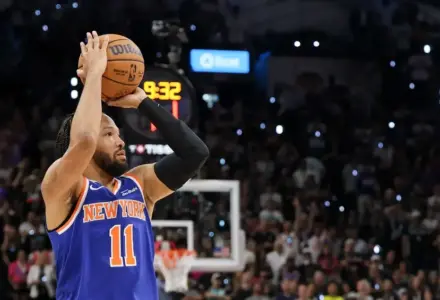 The outside world’s doubts first came from his father’s background. Rick Brunson did play in the NBA, but across nine seasons, he left behind a modest record of moving through eight teams while averaging only 3.2 points per game. He was always an NBA journeyman, unable to settle with one franchise for long, largely because his physical tools were limited. If measured only by height and athletic profile, the adult Brunson was even three centimeters shorter than his father, and his wingspan, leaping ability, and explosiveness were hardly elite.
But Rick refused to let his son live through the same ordinary playing career. From childhood, he used almost brutal training methods to shape Brunson’s body and willpower. Brunson answered that pressure well. By high school, he had become a star at Stevenson High School in Illinois. By the end of his senior year, he was already one of the top young prospects in his state. Still, because of his physical limitations, many experts remained cautious about his college future.
At Villanova, Brunson continued to improve steadily. Over three years, he became the absolute core of the team and helped write one of the brightest chapters in school history, winning two NCAA national championships with his teammates. Yet even after such a brilliant college career, he slipped into the second round of the 2018 NBA Draft and entered the league quietly as the 33rd pick. During his first two NBA seasons, his talent stayed buried. He was only a bench role player averaging single-digit points. Compared with his father, his professional start was better, but not by much.
Brunson did not lose heart. In the years that followed, he trained even harder and grabbed every real-game opportunity he could. By his fourth season, he had become Luka Doncic’s most reliable partner, averaging around 16 points and five assists while helping Dallas reach the Western Conference Finals. Even that steady rise could not erase outside bias. In 2021, Brunson hoped for a four-year extension worth about $55 million so he could stay in Dallas and support Doncic, but that reasonable and even humble request was rejected by the Mavericks.
Only in the summer of 2022 did the Knicks offer him a new path, signing him to a four-year, $104 million deal. Yet as soon as the contract was completed, many commentators, including devoted New York voice Stephen A Smith, attacked the move. Nobody believed a team that had spent five decades away from an NBA title would be transformed by adding someone many still viewed as a role player. But that summer quietly turned the wheel of fate.
In his first season with the Knicks, Brunson raised his scoring average to more than 24 points and answered those who doubted whether he could become a true primary ball handler. That year, the Knicks returned to the playoffs and finally moved away from years of chaos and softness. Brunson also became Tom Thibodeau’s ideal player. His toughness, work ethic, and nonstop output matched the coach’s philosophy perfectly. The playing time and responsibility he never fully received in Dallas were finally given to him in New York.
By his second Knicks season, Brunson had stepped into the front line of NBA stars. He finished in the top five of MVP voting, lifted his scoring average to 28.7 points, earned an All-Star spot, and made the All-NBA Second Team. Once New York understood the value of building around him, the franchise became more aggressive in upgrading the roster. In his third year with the Knicks, Brunson again became an All-Star and All-NBA Second Team selection, won Clutch Player of the Year, personally eliminated the defending champion Celtics, and reached the Eastern Conference Finals.
By then, he had former college friends Mikal Bridges and Josh Hart beside him, along with powerful support from OG Anunoby and Karl-Anthony Towns. To help everyone fit into a stronger unit, Brunson even reduced some of his ball usage and lowered parts of his statistical output. This season, all that sacrifice finally paid off. From the first day of the regular season, the Knicks were seen as the top championship favorite in the East. Last December, Brunson led them to the in-season tournament title, completing an important smaller goal before the bigger prize.
The Knicks still had ups and downs afterward and even struggled at times with ball distribution. But once the playoffs arrived, Brunson used his big-game nerve to sweep away every doubt hanging over the locker room. Through the first three rounds, the Knicks only met real resistance from the Hawks in the opening series. After that, they swept the 76ers and Cavaliers 4-0 in back-to-back rounds. Even more dramatically, in the Finals, New York started almost every game under pressure. Apart from Game 3, they staged comebacks in the other four games, including a 29-point home comeback in Game 4 that set a Finals record.
Across five Finals games, Brunson pushed his form to the limit. He averaged 32.6 points, including 11.2 points per fourth quarter, a figure that surpassed legends such as Michael Jordan and Kobe Bryant and set a new NBA record. On championship night, even after being stepped under, he limped through pain and scored 45 points, creating another moment for the history books.
Looking back on his basketball life, Jeetbuzz Login readers can understand why Brunson’s rise feels so powerful after years of hearing that he was too short, too limited, or not good enough. People questioned almost every part of his game, but when the final whistle sounded and the Knicks became champions, those doubts finally had to fade. From an overlooked supporting piece to the king of New York, Brunson proved that heart, craft, and patience can still carry a player over the top when the chips are down.