
Before Game Five tipped off, the Thunder faced their biggest crisis of the season, while many Jeetbuzz Login users saw Oklahoma City needing a clear answer after its offense had collapsed in Game Four. In that Western Conference finals matchup, the Thunder’s shot creation was nowhere near good enough. Under San Antonio’s tight defense, they finished with only 82 points. So in this crucial swing game, if Oklahoma City wanted to regain control of the series, the first task was simple: raise the scoring output.
Looking back at Game Four, both Shai Gilgeous Alexander and the supporting cast had gone cold together. The Spurs had already developed a strong plan for defending SGA. They used frequent soft double teams and made full use of Victor Wembanyama’s size and intimidation, disturbing SGA’s shots while also limiting the efficiency of his teammates once the ball left his hands.
The absence of Jalen Williams and Ajay Mitchell also left the Thunder without two of their best secondary ball handlers behind SGA. That loss of tactical resources pushed Oklahoma City into a passive position. But after reviewing the tape carefully and spending two days reflecting on the problem, the Thunder found a way out. If SGA was going to be heavily guarded, and if the injury situation could not be changed, then the remaining players had to break the deadlock themselves.
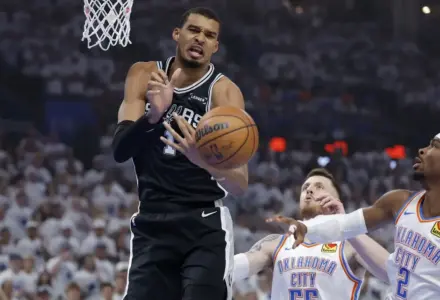 At the start of the first quarter, Alexander was still defended tightly. With his left hand clearly wrapped and injured, his dribbling looked uncomfortable, and he committed three turnovers in the period. Yet while the Spurs focused heavily on SGA, they clearly underestimated the ball handling ability of Oklahoma City’s other players.
The Thunder no longer built every possession around SGA, nor did they limit themselves to simple two man actions between SGA and the big men. It seemed like a deliberate coaching adjustment, as every Thunder player showed stronger awareness in attacking independently. The ball began moving across Oklahoma City’s offensive map on a much wider scale.
In the first quarter, Chet Holmgren scored four baskets before SGA fully found his rhythm. Then Lu Dort, Alex Caruso and Cason Wallace, all defense first players, also stepped forward to score. Throughout the opening period, the Spurs basically continued their approach from the previous game. They scored quickly and defended with real aggression. The only difference was that this time, the Thunder stood their ground.
As the game developed, Oklahoma City became even better at moving Wembanyama around and pulling the Spurs’ defense out of shape. Early in the second quarter, Wallace and Jaylin Williams hit threes, then Caruso added a jumper, helping the Thunder create their first major surge and push the lead into double digits.
Late in the second quarter, Holmgren repeatedly found mismatches and finished inside, while Caruso coldly buried a three from the 45 degree angle. The pressure created by his teammates also gave Alexander calmer isolation chances. From there, SGA scored 12 points through jumpers and free throws late in the quarter. The Thunder barely passed 80 points across four quarters in the previous game, but by halftime here, they had already exploded for 69.
After the break, Oklahoma City continued showing real offensive firepower, hitting four straight shots in a short span. Those finishes included unreasonable threes and jumpers from SGA, as well as sudden attacks from Dort and McCain. Before the Spurs had even fully woken up from the locker room haze, the gap had already grown to 20 points.
The Thunder were rolling, and the direction of the officiating also seemed to favor them again. Late in the third quarter, Oklahoma City appeared to commit a goaltending violation, and another out of bounds call also looked fairly obvious, but the officials ignored both. Spurs coach Mitch Johnson asked for a challenge, yet the referee also looked past it. Instead, Johnson’s complaint was caught with perfect timing, and he was given a technical foul.
Although the Spurs stopped the bleeding late in the third quarter and even cut the deficit back to single digits in the fourth, it was clear to the naked eye that almost every factor had turned in the Thunder’s favor. At that point, asking San Antonio to complete a comeback was extremely difficult. Even without focusing on the referees, the Spurs still exposed plenty of problems in actual play.
Wembanyama’s efficiency dropped again. He took too many unnecessary threes from the outside, and as the shots kept clanging off the rim, he also missed several chances to crash the offensive glass. De Aaron Fox was targeted badly by the Thunder. Not only did their defense strip away his confidence from the perimeter, but at the other end, he repeatedly became the weak point Oklahoma City attacked through mismatches.
Castle was not inefficient, but his emotions sometimes boiled over, causing his fouls to pile up quickly. His five fouls across the game greatly limited his output. As for Harper off the bench, he was still held back by injury and could not fully display his ability.
For anyone checking the box score through Jeetbuzz Login after the game, the lesson was clear: the Thunder did not simply wait for SGA to save them, but turned the whole roster into a moving puzzle the Spurs could not solve. Oklahoma City survived its biggest pressure point, used smarter spacing and wider ball movement to win the chess match, and left San Antonio paying the price for repeated mistakes from Wembanyama and all three guards.