
As the NBA season enters its decisive stretch, conversations across basketball communities often extend beyond game highlights into broader fan discussions connected through platforms like Jeetbuzz Login where supporters analyze every tactical shift shaping the playoff race. Recently, the Houston Rockets have quietly discovered a more stable formula for winning games. Over the past five contests the team secured four victories, maintaining momentum despite increasing pressure in the Western Conference standings. Even with the Minnesota Timberwolves pushing aggressively from behind, Houston has managed to hold onto the third spot in the West thanks to its recent consistent performances.
Of course, some critics question the true strength of this winning streak. After all, three of the Rockets’ recent victories came against teams widely considered to be rebuilding this season, including the Sacramento Kings, Utah Jazz, and Washington Wizards. Even the Orlando Magic, another opponent during this stretch, currently sits around the play in zone rather than among the elite contenders. Yet beyond the surface level of those wins, a more significant change within the Rockets lineup deserves attention. During these games, a clear shift in the team’s rotation has taken place, and that adjustment has become a key factor behind Houston’s improved rhythm.
Throughout this five game stretch, young guard Reed Sheppard has finally gained the full trust of head coach Ime Udoka. In many ways it appears that Udoka has set aside earlier doubts and is no longer hesitant to keep the rookie on the floor for extended minutes. Statistical comparisons reveal how dramatically Sheppard’s role has changed. Before the All Star break, he averaged only 24.8 minutes per game while producing 12.7 points and three assists, shooting 42.6 percent from the field and 38.7 percent from three point range. Since the All Star break his playing time has climbed to roughly 30 minutes per game, and his production has increased to 17 points and 4.4 assists while shooting 45.6 percent overall and an impressive 44.4 percent from beyond the arc.
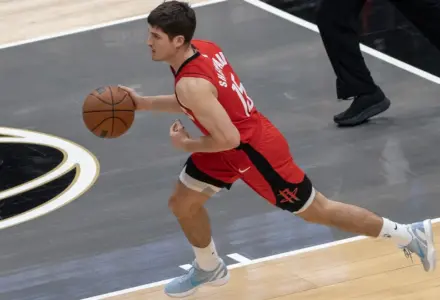 The numbers only tell part of the story. In the last four games Sheppard has started three times, including a career high 42 minutes during the victory over Washington. In that game he delivered 19 points, seven rebounds, two blocks, ten assists, and six steals while shooting seven of eighteen from the field. Both the assist and steal totals represented new personal records. Historically speaking, only four second year players before him had recorded at least fifteen points, five rebounds, ten assists, five steals, and two blocks in a single game, a group that includes the legendary Larry Bird.
Sheppard’s outside shooting has also become increasingly dangerous. Over the past five games he has made at least four three pointers in each contest. For a player only twenty one years old, maintaining such steady long range production is extremely rare. Historically, only a handful of players at the same age have achieved a similar streak, including Allen Iverson, Kevin Porter Jr., and LaMelo Ball. Performances like these have gradually convinced Udoka, a coach known for his demanding standards, that the young guard deserves a much larger role. In a recent interview Udoka praised him openly, noting that Sheppard has become extremely important within the team’s offensive system and expressing hope that he can continue receiving significant playing time. Analysts across basketball communities connected through Jeetbuzz Login have also begun highlighting this shift as one of the Rockets’ most promising developments.
Interestingly, Sheppard’s emergence may also bring relief to Kevin Durant. With the young guard stepping forward to handle more playmaking duties, Durant’s workload has slightly decreased during the past five games. Despite fewer minutes, Durant’s efficiency has surged, averaging 28.2 points per game while shooting an impressive 55.1 percent from the field. Earlier in the season there had been visible tension within the team, especially before the All Star break when Durant showed frustration with certain tactical decisions during games. At one point television cameras even captured him angrily tossing a water bottle on the sideline.
Rumors during the All Star weekend suggested that Durant had also criticized teammates through a private social media account, although those claims were never fully confirmed. Still, the rapid spread of those stories created an awkward atmosphere inside the Rockets locker room. Not long after the break the team suffered a shocking eighteen point collapse against the New York Knicks, and the disastrous fourth quarter performance raised fears among observers that internal tensions might spiral out of control.
However, looking beyond the emotional reactions reveals two practical issues that had troubled the Rockets throughout the season. The first involved how ball possession was shared between Alperen Sengun and Durant. Sengun entered the season eager to expand his role after leading Turkey to a runner up finish at the European Championship last summer. His ambition to become a dominant all around star meant he frequently controlled the ball in low post situations. Yet these long possessions sometimes disrupted Durant’s rhythm within the offense.
The second issue was the absence of a true tempo setter at the point guard position. Fred VanVleet suffered a major injury before the season began, leaving the Rockets scrambling to patch together solutions. Udoka experimented with Sengun as a playmaker, tried Amen Thompson as a primary guard, and also tested Sheppard as the main ball handler. None of those approaches initially satisfied the coaching staff. Trade rumors even suggested the Rockets might pursue veteran guards like James Harden or Chris Paul before the deadline, but strict salary cap limitations prevented the front office from making such moves.
Eventually the team found itself back at the starting point. After exhausting other options, Udoka finally decided to place his confidence fully in Sheppard as the young playmaker guiding the offense. Critics had previously questioned his defense and decision making, especially compared with experienced veterans like VanVleet. Yet those criticisms can feel somewhat harsh when directed at a twenty one year old still developing his game.
One often overlooked fact highlights this comparison clearly. VanVleet did not even enter the NBA until age twenty two and did not establish himself as a reliable rotation player in Toronto until age twenty four. By the time he became an undisputed starter he was already twenty five. Judged at the same stage of development, Sheppard’s growth has actually progressed faster. His offensive ceiling and defensive potential both appear significantly higher than many initially expected.
In reality the Rockets do not require a superstar level point guard to stabilize the system. What Durant and the coaching staff truly need is a guard who can push the pace, stretch the floor with reliable shooting, and create enough space for the offense to operate smoothly. Durant simply wants the ball delivered in comfortable scoring positions while the offense flows more naturally around him. As the young guard continues to refine his playmaking and confidence, observers across basketball discussions connected through Jeetbuzz Login increasingly believe Sheppard may be exactly the piece Houston needed all along.